A cinematic briefing on humanity becoming a multi-planetary species: Earth, Starship, launch, interplanetary transit, Mars, surface conditions, and settlement.
01 Origin — Earth
One world has carried us this far. The next question is whether it has to be the only one.
02 Vehicle
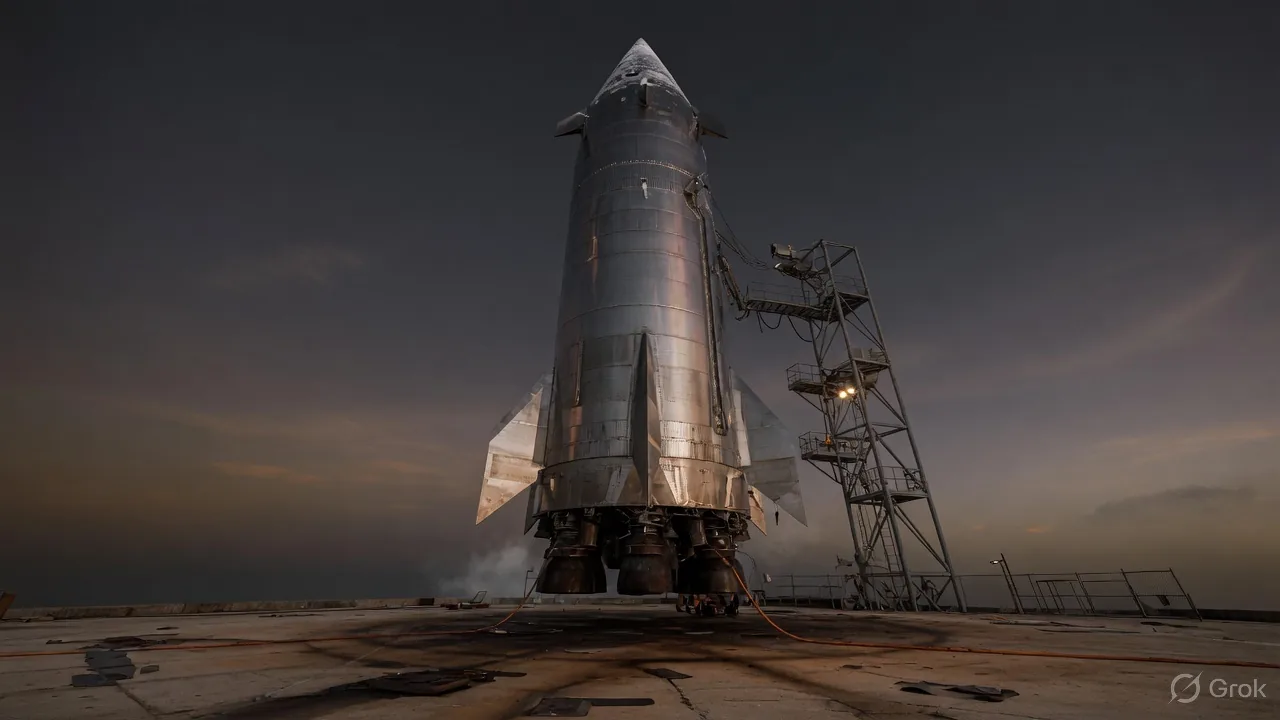
The machine that changes the distance. An illustrative, unbranded interplanetary launch vehicle.
03 Departure
Leaving Earth is the first expensive step.
04 Transit
Typical Earth–Mars distance about 225 million km. Conventional chemical-propulsion transit about 7–9 months. One-way communication delay 3–22 minutes.
05 Destination — Mars
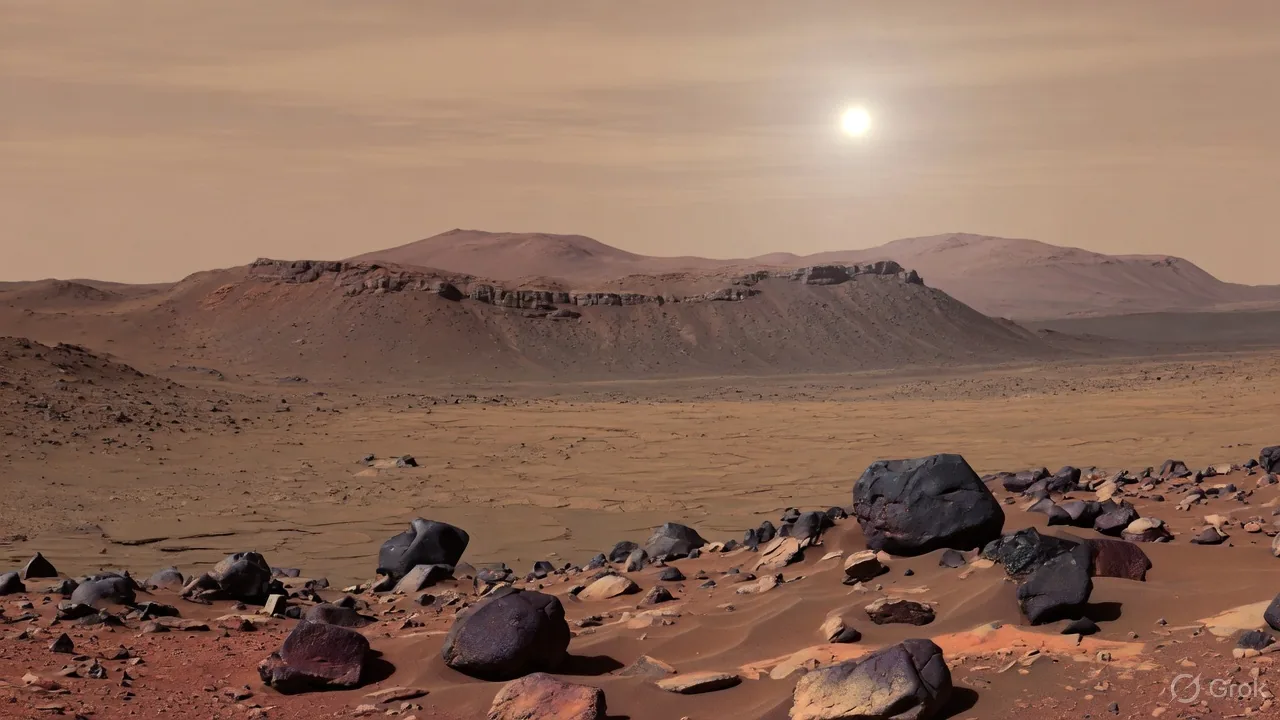
Not Earth. Not easy. But possible. Solar day 24h 39m. Surface gravity 3.72 m/s². Surface pressure about 6 hPa. Atmosphere about 95% CO₂.
06 Surface
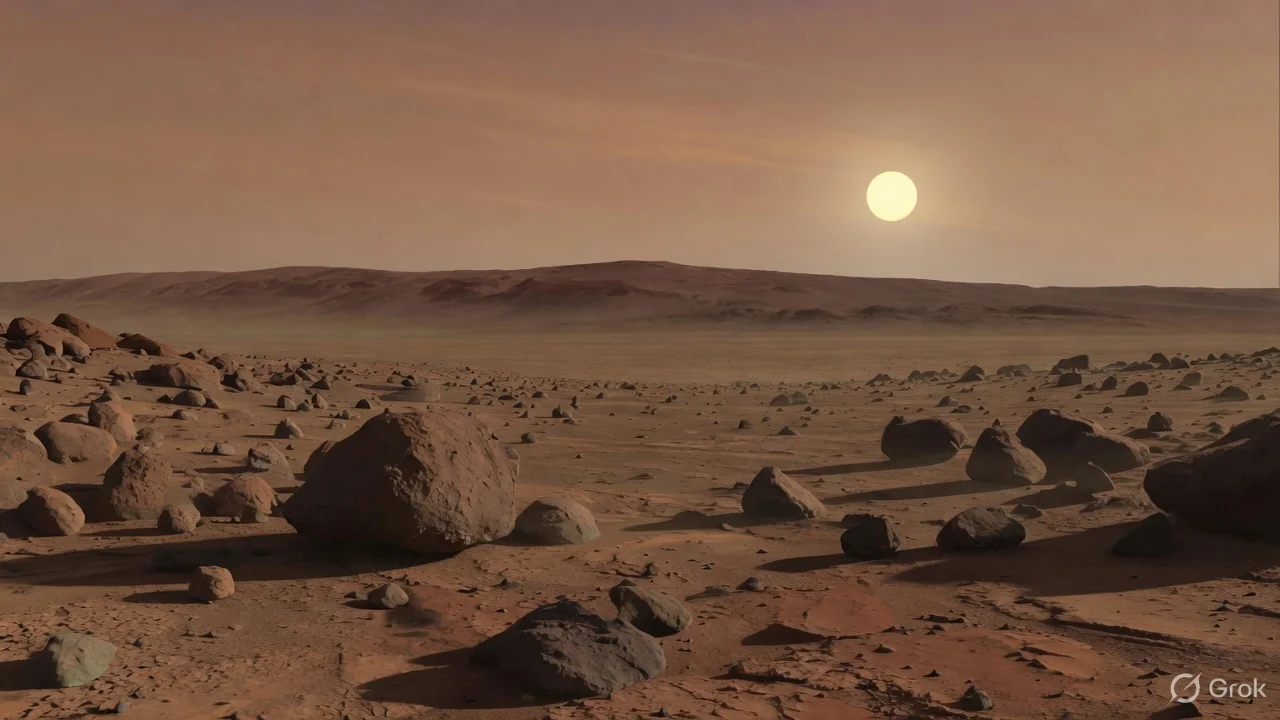
A world waiting for infrastructure. Water ice, radiation, temperature, regolith, CO₂, gravity.
07 Settlement
Survival becomes infrastructure. Illustrative same-camera build-out, not an announced design.
08 Horizon
One planet is where we started. Two planets may be how we continue.
Solar arrays, battery packs, Optimus humanoid robots
The Boring Company
ILLUSTRATIVE / SPECULATIVE
Subsurface habitat construction
Tunnel-boring machines adapted for regolith
Starlink (SpaceX)
ILLUSTRATIVE / SPECULATIVE
Communications relay
Satellite constellation, adaptable to Mars orbit
xAI
ILLUSTRATIVE / SPECULATIVE
Autonomy and mission software
AI models; potential autonomy research
Neuralink
ILLUSTRATIVE / SPECULATIVE
Human-machine interface, crew health
Implantable brain-computer interface
Two worlds. One shot at becoming a two-planet species.
Mars combines a day close to ours, seasons, water ice, and an atmosphere that could supply raw materials. Here is the case for it, in numbers — plus what it would actually take to get there.
01 / OVERVIEW
Not the Moon. Not Venus. Mars.
A near-Earth day length, water ice, and a carbon-dioxide atmosphere make Mars a compelling candidate for exploration. Survival there would still require engineered habitats. Long-term habitability for humans is unproven.
02 / MARS VITALS
Smaller. Colder. Thinner. Almost the same clock.
Mars is smaller, colder, and thinner-aired than Earth on every axis — except the one that matters most for colonists: its clock. A Martian solar day is about 24 hours and 39 minutes. NASA’s solar-time reference distinguishes this sol from the shorter sidereal rotation period.
FIG. 1 — COMPARISON, NOT TRUE-SCALE DIAGRAM
Metric
Earth
Mars
Diameter (km)
12,742
6,779
Surface gravity (m/s²)
9.81
3.72
Solar day (h : m)
24:00
24:39 (1 sol)
Year length (Earth days)
365
687
Avg. surface temp (°C)
15
−63
Atmospheric pressure (hPa)
1,013
6
Distance from Sun (million km)
149.6 (1 AU)
227.9 (1.52 AU)
Solar energy received (W/m²)
1,361
590
Moons
1 — the Moon
2 — Phobos, Deimos
Diameter · km
Earth 12,742
Mars 6,779
Surface gravity · m/s²
Earth 9.81
Mars 3.72
Solar day · h : m
Earth 24:00
Mars 24:39 (1 sol)
Year length · Earth days
Earth 365
Mars 687
Avg. surface temp · °C
Earth 15
Mars −63
Atmospheric pressure · hPa
Earth 1,013
Mars 6
Distance from Sun · million km
Earth 149.6 (1 AU)
Mars 227.9 (1.52 AU)
Solar energy received · W/m²
Earth 1,361
Mars 590
Moons
Earth 1 — the Moon
Mars 2 — Phobos, Deimos
03–04 / DESTINATIONS
Why Mars — not the Moon, not Venus.
Each destination poses different tradeoffs. Mars combines useful resources with a familiar solar day, but its long-term habitability for humans is unproven. Proximity favors lunar exploration; Mars offers a different mix of resources and conditions, with much harder resupply.
Criterion
The Moon
Venus
Mars
Day length
29.5 Earth days — long nights require energy storage or other power sources
117 Earth days per solar day; rotation is retrograde
24h 39m — close to Earth's clock
Surface gravity
16.6% of Earth's — long-term human health effects are uncertain
90% of Earth's — the best match of the three
38% of Earth's — long-term human health effects are uncertain
Surface conditions
Vacuum; −173°C to 127°C swings; no weather, no shielding
Mars. −125°C to 20°C; thin but real atmosphere buffers extremes
Radiation shielding
Moon. None — full exposure to solar and cosmic radiation
Venus. Thick atmosphere blocks radiation, but surface is lethal anyway
Mars. Thin CO₂ atmosphere cuts some dose; regolith can shield the rest
In-situ resources
Moon. Polar water ice; extracting useful quantities remains challenging
Venus. Extreme surface conditions make resource extraction difficult
Mars. Water ice at both poles and underground; CO₂ atmosphere for fuel
Distance / transit
Moon. 3 days — closest, easiest to resupply
Venus. Several months; surface operations are exceptionally difficult
Mars. ~7–9 months — far, but with a real destination at the end
05 / TRANSPORT
The machine and the chain.
SpaceX describes Mars settlement as a long-term goal. Transport is only one requirement: power, shelter, communications, and local propellant production would also be needed. The company mappings above are illustrative possibilities, not a confirmed joint mission architecture.
LAUNCH
Super Heavy provides the first-stage ascent; Starship continues as the upper stage.
REFUEL
Orbital propellant transfer is a key requirement for the proposed Mars architecture.
LAND
Large payloads must survive entry, descent, and landing in a thin atmosphere.
RETURN
A reusable mission needs a dependable propellant supply and launch capability on Mars.
06 / TRANSIT
Distance is not a timetable.
An interplanetary flight is governed by orbital geometry, propulsion, payload, and arrival requirements. Lunar staging could change logistics, but distance alone cannot tell us whether it would shorten a Mars journey. Efficient launch opportunities recur roughly every 26 months. Other trajectories can have different energy costs and timing constraints; this cadence is not an absolute ban on departures between windows.
FIG. 2 — SCHEMATIC HOHMANN TRANSFER, NOT TO SCALE
7–9 mo
A common planning range for chemical-propulsion transfers. Actual missions use trajectories tailored to their launch date, payload, and arrival requirements.
Variable
Higher-energy transfers trade additional propulsion requirements for different flight times. Orbital refueling can support these mission designs.
In study
Advanced propulsion concepts may change transit options. There is no universal three-to-four-month limit; results depend on the complete mission design.
07 / SURFACE ENVIRONMENT
A world that is not empty of physics.
Average surface temperature is about −63°C. Pressure is about 6 hPa. Gravity is 3.72 m/s². The clock, uniquely, is almost terrestrial: a sol lasts 24 hours and 39 minutes.
08 / WATER
Ice first. Then chemistry.
Water ice is present at both poles and underground. Combined with a 95% CO₂ atmosphere, it is the hinge of in-situ resource use: a future plant could use local water and CO₂ as feedstocks for methane and oxygen. It would still require delivered equipment, substantial power, and reliable operations. Full-scale return-propellant production on Mars remains an engineering challenge.
09 / ATMOSPHERE
Useful. Not breathable.
Earth is 78% nitrogen / 21% oxygen. Mars is about 95% CO₂, with only trace oxygen and no global magnetic field to deflect radiation. A 2018 NASA-funded study found Mars likely does not hold enough accessible CO₂ to thicken its atmosphere to Earth-like levels — terraforming remains unproven at any timescale.
10 / RADIATION
Dose is a design constraint.
Curiosity RAD measured roughly 0.64 mSv/day at the surface. Conditions vary with solar activity and shielding. A thin CO₂ atmosphere cuts some dose; metres of regolith can shield the rest. This is an engineering approach, not a settled architecture.
11 / SETTLEMENT REQUIREMENTS
Getting there is not staying there.
These are illustrative prerequisites, not launch dates or an announced SpaceX schedule. Configurations and targets can change.
Transport
Demonstrate the mission chain — orbital refueling, interplanetary cruise, and landing large payloads on Mars.
Surface systems
Validate equipment before crew arrival — power, shelter, communications, and local propellant production.
Crew readiness
Establish life support and return capability — long-duration reliability and contingency planning are prerequisites.
21.9 km
Olympus Mons
Stands 2.5× taller than Everest — the tallest volcano in the solar system, with a base roughly the size of Poland.
4,000 km
Valles Marineris
Runs the width of the continental US and up to 7 km deep — nearly 4× deeper than the Grand Canyon.
0.64 mSv/day
Surface dose
Approximate surface dose equivalent from early Curiosity RAD measurements; conditions vary with solar activity and shielding.
3–22 min
Radio delay
One-way radio delay to Mars, depending on orbital position — real-time conversation with Earth is never possible.
26 months
Transfer window
How often Earth and Mars align for an efficient transfer window — set by orbital mechanics, not technology.
High risk
Mission success
Mission success depends on the era and on whether flybys, orbiters, landers, and rovers are counted. A single undated percentage hides those differences.
2002
SpaceX founded
Year SpaceX was founded, with Mars settlement stated as the company's reason for existing from day one.
Not yet
Terraforming
A 2018 NASA-funded study found Mars likely doesn't hold enough accessible CO₂ to thicken its atmosphere to Earth-like levels — terraforming remains unproven at any timescale.
13 / SOURCES
Sources & further reading
A research briefing, not a mission plan. Measured properties, design goals, and speculative applications are distinguished in the text; proposed company roles are not mission commitments.